Free Forge app · Confluence Cloud · No OAuth scopes
You already produce all three. Just not in the same place, or the same shape.
The RACI matrix, the service review and the agreed targets — three native Confluence
macros, instead of a spreadsheet, a document and someone’s inbox. The RACI matrix can
start from any of 34 practice templates. Free, no OAuth scopes, and nothing stored
outside the page.
Not listed yet — it goes to the Atlassian Marketplace once it has passed review.
The button opens your own mail client.
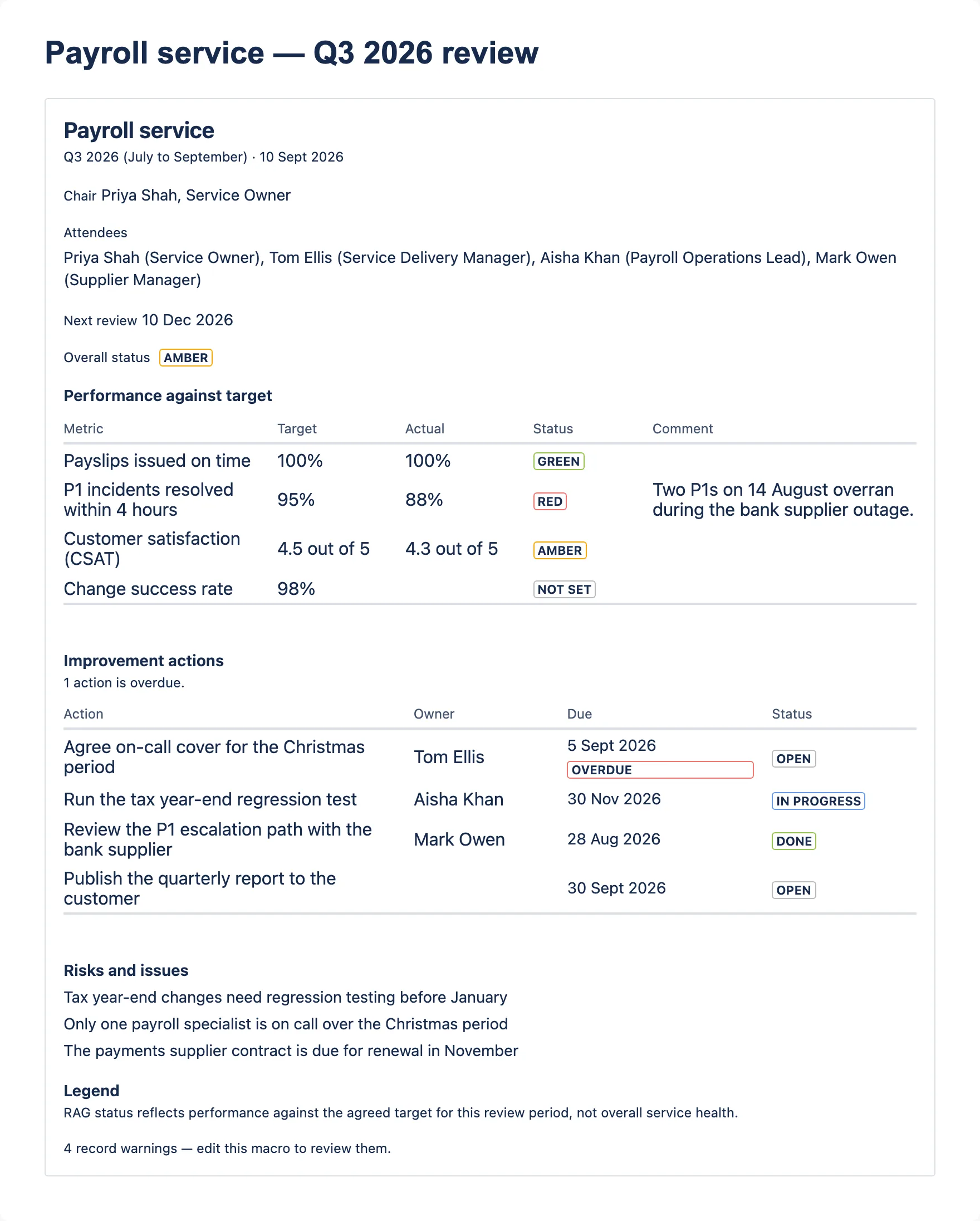
A completed service review, on the page. The overdue action is judged against the reader’s own local date, not the server’s. Describe this screenshotA service review record headed “Payroll service”, subtitle “Q3 2026 (July to September) · 10 Sept 2026”. Chair, Attendees and Next review lines follow, then “Overall status” with an AMBER label. Under the heading “Performance against target”, a KPI table lists four metrics with Target, Actual, a coloured Status and a Comment. Under the heading “Improvement actions”, small text reads “1 action is overdue.” above an actions table in which the first action’s due date, 5 Sept 2026, is bold with a red OVERDUE label. “Risks and issues” lists three lines, a “Legend” heading introduces a sentence explaining what RAG status reflects, and small text at the foot reads “4 record warnings — edit this macro to review them.”
RACI matrices, service reviews and service level targets, built into your Confluence pages, not bolted on.
Every screenshot here is a real render of the app’s own code, drawn with the same
Atlassian components Confluence uses. People, services and figures are fictional.
What that does and does not guarantee →
The gap
The three you have now, and why nobody opens them.
If you run service reviews, a RACI matrix, a review record and a set of agreed targets
already exist — usually as three inconsistent documents scattered across a wiki, a
spreadsheet and someone’s inbox.
The RACI nobody reopens
Built in a workshop, exported to a spreadsheet, pasted into a page as an image.
Six months later nobody can edit it and nobody trusts it.
The review written up differently every quarter
Whoever chaired it chose the headings. Comparing Q1 with Q3 means reading both in
full, and the actions live in a different document again.
The SLA whose clock nobody agreed
Four hours to resolve — but four hours of what? The argument arrives at the worst
possible moment, which is during the incident.
What you get
What replaces the spreadsheet, the document and the inbox.
Native Confluence macros — not an embedded app, not a screenshot of a spreadsheet.
They are edited in Confluence, versioned by Confluence, and exported by Confluence.
RACI Matrix
Start from any of 34 practice templates or a blank grid: one column per role, one row per activity — and a warning the moment two roles are accountable for the same thing.
RACI MatrixSays who is accountable, and when nobody is
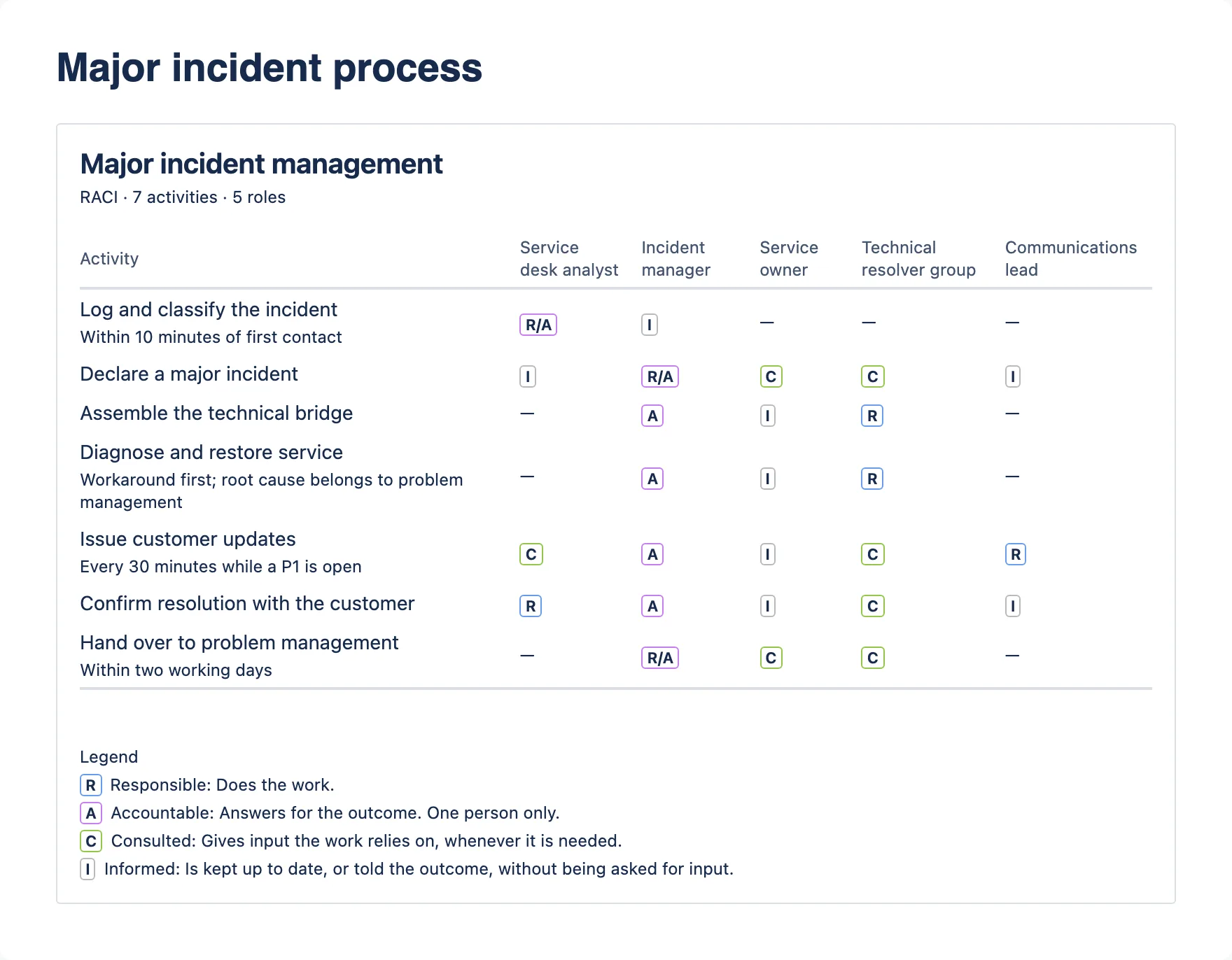
A RACI (or RASCI) matrix that can start from any of 34 practice templates, with advisory validation: it warns when accountability is missing or shared, but never blocks you from saving a matrix mid-workshop.
Three of the seven things it says out loud, none of which stop you saving:
“Log the incident” has no accountable role. Exactly one role should be accountable.
“Authorise the change” has 2 accountable roles. Accountability cannot be shared — choose one.
“Implement the change” has no responsible role. At least one role should do the work.
A published RACI matrix. Every cell carries its letter as text, so the colour is never the only thing saying what it means. Describe this screenshotA RACI matrix titled “Major incident management”, subtitle “RACI · 7 activities · 5 roles”. Activities run down the left, some with a short note in smaller text; five role columns run across. Cells hold coloured letter labels such as R/A, A, R, C and I, or a dash. A legend underneath explains R, A, C and I.
Macro 2 of 3
Service Review RecordRun the review, keep the record
A structured service review record with RAG status, a KPI table and improvement actions that track owner, due date and status, shown as overdue against each reader’s own local date.
Three of the six gaps it names while the meeting is still in the room:
“Change success rate” has a target but no actual. A review without the number achieved cannot show whether the target was met.
“Customer satisfaction (CSAT)” is Amber with no comment. Say why, while the reason is still fresh.
“Publish the quarterly report to the customer” has no owner. An action nobody owns is not an action.
A completed service review, on the page. The overdue action is judged against the reader’s own local date, not the server’s.
Macro 3 of 3
Service Level TargetsState the target, stop the argument
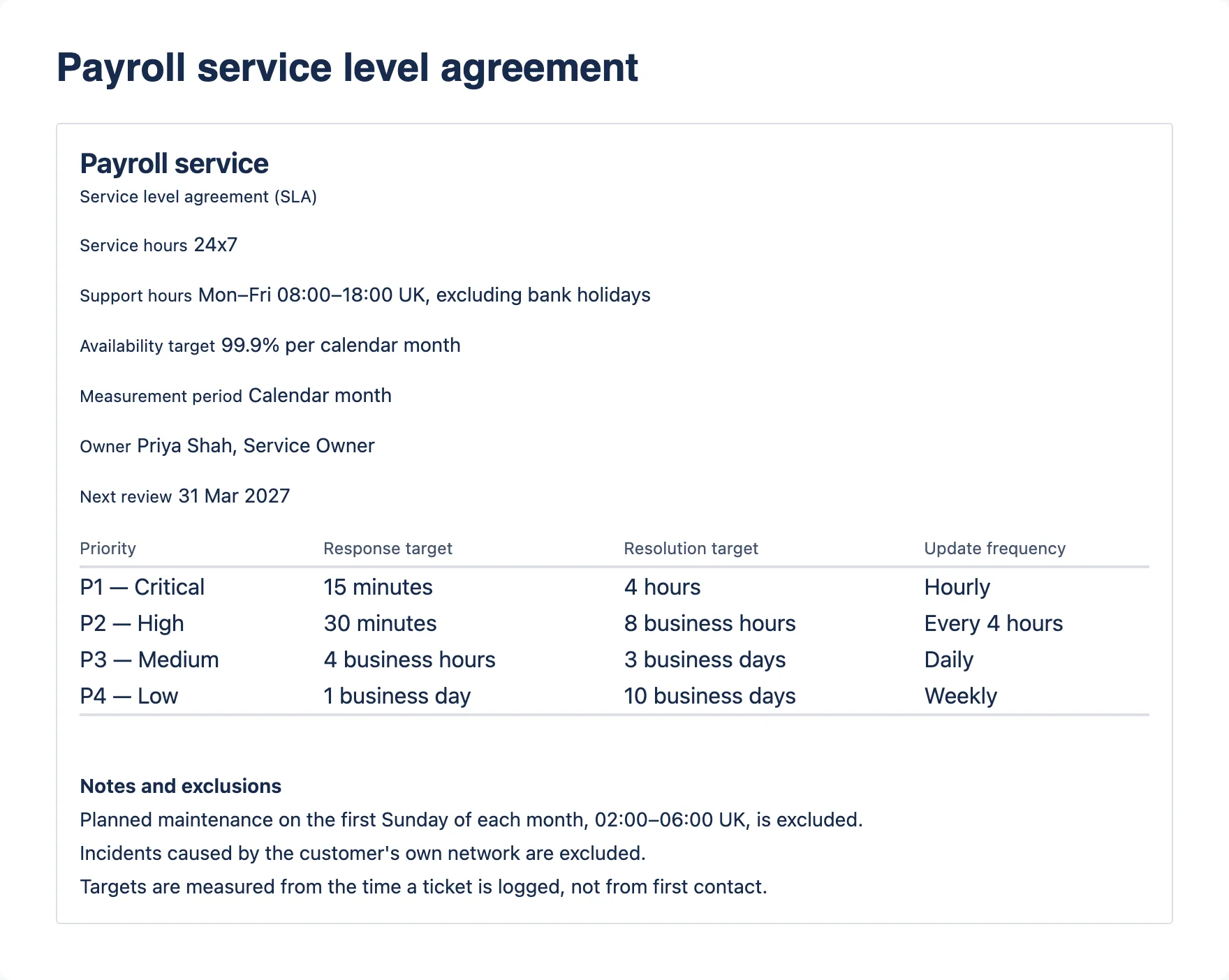
Service level targets by priority, with service hours and support hours as separate fields, so what is agreed and what is disputed are no longer the same conversation.
Three of the four arguments it settles now rather than during the incident:
“P5 — Planned work” has neither a response nor a resolution target. A priority with no time against it commits to nothing.
“P2 — High” is used for more than one target. A reader cannot tell which one applies.
The update frequency column is switched on but no target has one, so it renders as an empty column. Fill one in, or switch the column off.
Service hours and support hours are separate fields, because they are usually different — and conflating them is where the argument starts. Describe this screenshotA service level targets macro headed “Payroll service”, subtitle “Service level agreement (SLA)”. Detail lines show Service hours 24x7, Support hours Mon–Fri 08:00–18:00 UK excluding bank holidays, Availability target 99.9% per calendar month, Measurement period, Owner and Next review 31 Mar 2027. A targets table lists P1 — Critical to P4 — Low with response, resolution and update frequency. Three notes and exclusions follow, including planned maintenance and when targets are measured from.
Who this is for
The people who chair the review, not just attend it.
Service owners, service delivery managers, change managers, and ITSM or SIAM process
owners who document services and governance in Confluence.
Readers, stakeholders and auditors
You read pages that contain these macros. You did not configure any of them, and you should not have to.
Process and practice owners
You own a process or an ITIL 4 practice, and you have to show who does what.
Service and service delivery managers
You chair the monthly or quarterly review, and you write it up afterwards.
Service level managers
You agree service levels, and then you have to defend them.
Confluence site administrators
You decide what gets installed, and you answer for it afterwards.
Each one has its own guide
Each one follows a single role end to end — from inserting their first macro to
maintaining what they built a year later.
FreeEvery macro, every feature. No tiers, no per-user cost.
No OAuth scopesIt cannot read your pages, your spaces or your users. It never asks to.
No external callsNo remotes, no analytics, no CDN, no fonts, no telemetry.
Zero invocationsA page view runs no Forge function at all, however many macros are on it.
Security
Your security review will be short.
There is no server, no database and no network call to assess. The app runs
entirely on Atlassian’s infrastructure, and everything typed into a macro stays in
the page it was typed onto.
No OAuth scopes — permissions.scopes is an explicit empty list
No remote services and no external permissions declared
No Forge storage, so nothing to retain after an uninstall
No analytics, no telemetry, no content delivery network, no external fonts
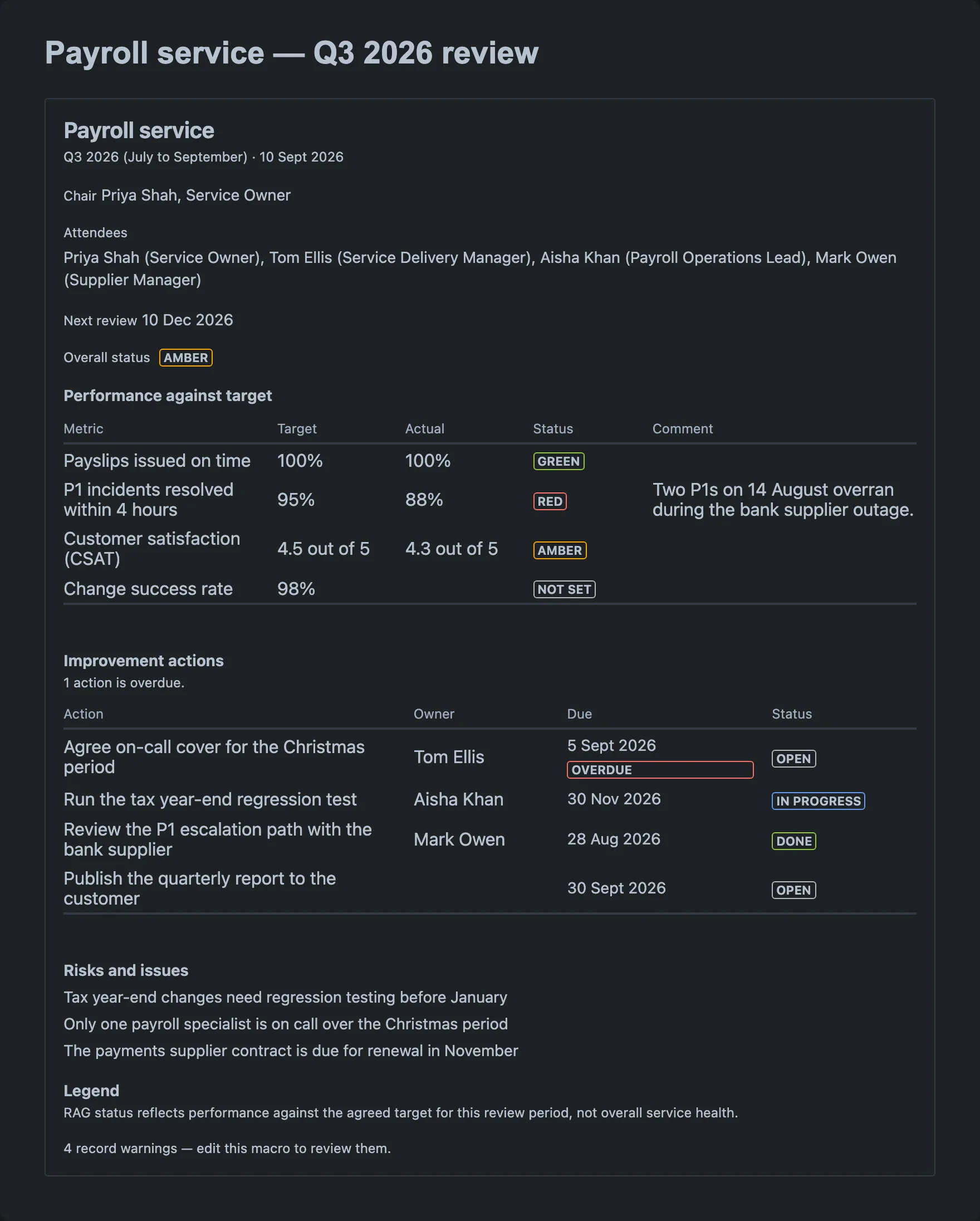
The same record in dark theme. The macros follow the reader’s Confluence theme, because every colour is an Atlassian design token rather than a hex value we chose. Describe this screenshotThe payroll service review record in dark theme. The text is light on a dark background; the AMBER, GREEN, RED, NOT SET and OVERDUE labels keep their colours and text.
Stated plainly
What it does not do.
Four limits worth knowing before you install rather than after. The full list, with
the reasoning behind each one, is on the features page.
No cross-page reporting
Each macro instance stands alone. There is no roll-up of every RACI in a space —
doing it properly would mean asking for permission to read your pages, and that
permission is exactly what makes this app easy to approve.
Configuration is a desktop job
The configuration dialogs were built for a desktop screen, and filling one in on a
phone is unpleasant. Reading is fine: the rendered macros are responsive and read
well in the Confluence mobile app.
Export fidelity is Confluence’s
The macros supply well-formed content, sized for a portrait page — a RACI matrix too
wide for its role names is exported with initials and a key. How the PDF or Word file
lays it out is Confluence’s rendering, not this app’s.
Not in Confluence search
Macro configuration is not opted into the search index, so text inside a macro is
not expected to appear in search results. That also means a search for a person’s
name can miss a review record that names them. Not yet verified on a live site.
Why it is free
Because the app is not the business.
ITSM Ltd is a UK service architecture practice. These three macros are the shape of that
work, made small enough to give away. If they are useful, install them and never speak
to us.
Three records, on the page the service already lives on.
One install by a site administrator, then nothing: no app permission to manage, no accounts to create, no licence to renew, and no change in cost at any number of users.
Not listed yet: it goes to the Atlassian Marketplace as a free app once it has passed review. The button opens your own mail client. You hear once, on the day it lists, and never again. What is in 2.7.0 →